Private Label vs Own Brand: What Should Small Manufacturers Choose?
Private label or own brand? A practical guide for small manufacturers deciding how to turn their production into a real D2C brand, plus the government schemes that support the journey.
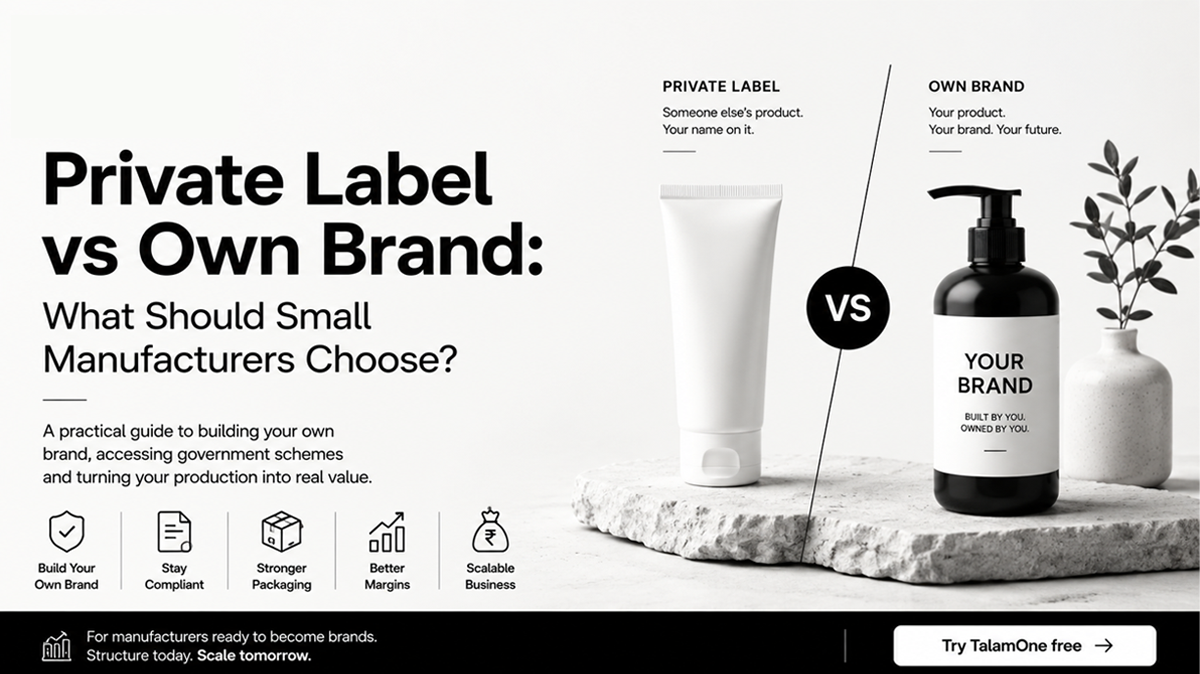
Private label means you put someone else's product under your name. Own brand means you build, formulate, and sell a product that is genuinely yours, even if a contract manufacturer produces it for you. For a small manufacturer already making a good product, own brand is almost always the stronger long-term path, because it's the only one that builds something you can sell, scale, or raise money against later.
Here's how to think about the choice, and how to actually make the move from manufacturer to brand.
Private Label vs Own Brand: The Real Difference
These two terms get used loosely, so let's be precise:
- White label: You take an existing, generic product (already formulated and made) and simply put your logo on it. You have no control over the formulation.
- Private label: A manufacturer produces a product to your specification, under your brand name. You have more control than white label, but you're still dependent on someone else's production line and capacity.
- Own brand (in-house manufacturing): You control the formulation, the production (yours or contracted to your spec), and the brand end to end. This is what most people mean when they say "building a real brand."
If you're already a home or small-scale manufacturer, you're often closer to "own brand" than you realize. The gap usually isn't production capability. It's brand identity, compliance structure, and a proper sales channel.
Which One Should You Choose?
Choose private label or white label if:
- You want to test a new category fast, with low investment
- You don't yet have manufacturing capacity for a new product line
- Speed to market matters more than differentiation right now
Choose own brand if:
- You already manufacture the product yourself and know it well
- You want pricing power and real margins, not a race to the bottom on cost
- You're building something you eventually want to be worth more than the sum of its sales, whether that's for a loan, an investor, or your own long-term equity
For most existing small manufacturers reading this, own brand is the natural next step. You already have the hardest part, the ability to make a good product. What's usually missing is everything around it.
The Real Gap: What's Missing Isn't Manufacturing
Most small manufacturers who stay stuck at "supplier" instead of becoming a "brand" are missing the same five things:
- A registered, protected brand identity — name, logo, and a filed trademark
- Compliant documentation — GST registration, correct HSN codes, category licenses (FSSAI, BIS, Ayush, as relevant)
- A direct sales channel — your own website or store, not just supplying to someone else's shelf
- A barcode and packaging system — GS1 barcoding is required by most marketplaces and retail chains
- A financial trail — clean books that prove the business is real, not just active
None of these require new machinery. They require structure.
Government Schemes That Support This Move
India has a meaningful set of schemes specifically built for manufacturers formalizing and scaling their business. The most relevant ones for a small manufacturer moving toward a real D2C brand:
- Udyam Registration: Free MSME registration. This is the gateway to almost every other scheme below, so it should be your first step if you haven't done it yet.
- CGTMSE (Credit Guarantee Fund Trust for Micro and Small Enterprises): Enables collateral-free loans for micro and small manufacturers, with the government guaranteeing a large portion of the loan amount. Useful if you need working capital or equipment financing without pledging personal assets.
- Design Clinic Scheme: Government support specifically for improving product design, which directly affects how competitive your packaging and product presentation look against bigger brands.
- MSE Cluster Development Programme (MSE-CDP): Support for manufacturers in the same region or category to access shared infrastructure and technology upgrades.
- Credit Linked Capital Subsidy Scheme (CLCSS): Subsidy support for technology upgrades that improve production quality or capacity.
- GeM (Government e-Marketplace): Once Udyam-registered, MSMEs get purchase preference and easier onboarding to sell directly to government departments, which can become a stable, additional revenue channel alongside your D2C sales.
Scheme eligibility, subsidy percentages, and application processes change periodically. Confirm current terms directly on the Ministry of MSME portal or with a registered consultant before applying, rather than relying on older guides.
The Practical Path From Manufacturer to Brand
- Register Udyam if you haven't. It's free and unlocks nearly everything else on this list.
- File your trademark early. Don't wait until the brand is well known, that's exactly when someone else can register it first.
- Get GST-compliant invoicing in place, even before your turnover requires it. Marketplaces and B2B buyers will ask for it regardless.
- Invest in packaging and a barcode system before you approach any marketplace or retail chain.
- Build a simple website or storefront so you're not entirely dependent on being someone else's supplier.
- Start tracking your numbers properly from the first sale under your own brand, not just from when it "feels real."
Where TalamOne Fits
This transition, from manufacturer to brand, is exactly where most founders lose momentum, not because the product isn't good enough, but because the compliance, invoicing, and structure never catch up to the ambition. <u>TalamOne</u> is a structured execution layer built for this exact stage: GST-aware invoicing, compliance tracking, and HSN code support, so your business looks and operates like the real brand it's becoming, not just a bigger version of the supplier you used to be.