How to Start a D2C Brand in India: The Complete Founder's Guide
A complete, practical guide for founders starting a D2C brand in India, from validating your idea to becoming investment-ready.
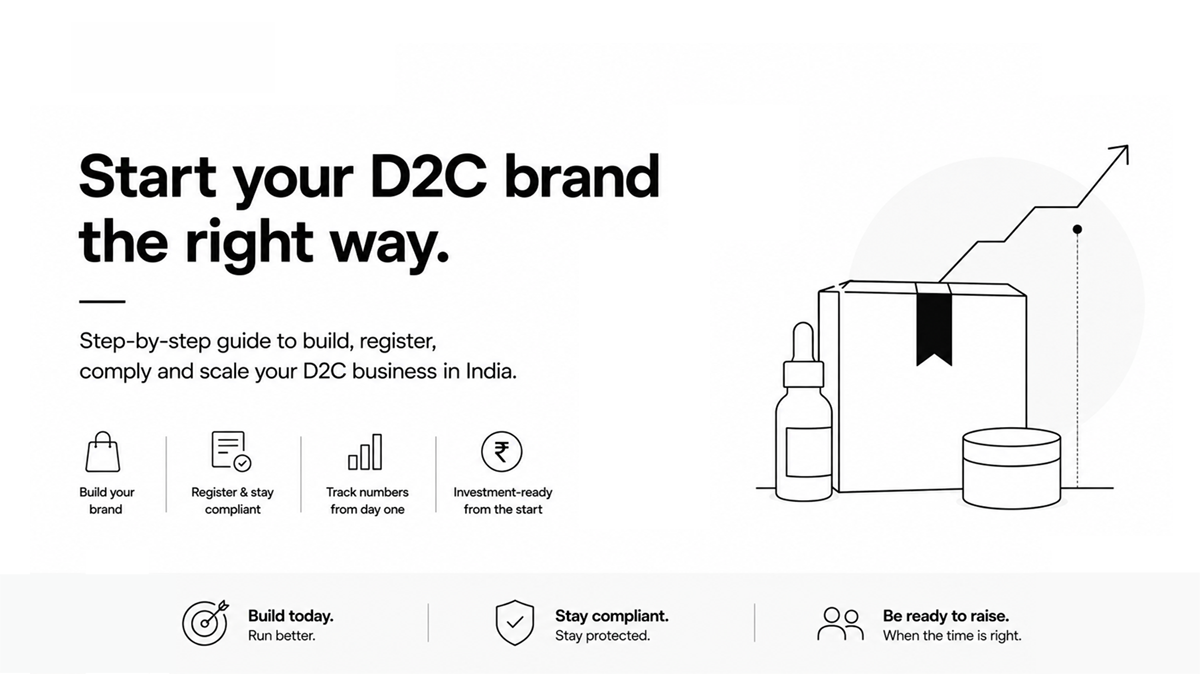
Starting a D2C (direct-to-consumer) brand in India means building a product, registering a legal business, setting up GST and compliance, creating a sales channel, and getting your first customers, in that order. Most founders skip steps 2 and 3 and pay for it later, when investors or lenders ask for records that were never created.
This guide walks through the full journey, step by step, in the order that actually works.
1. Validate Your Idea Before You Spend
Before you register a company or order inventory, confirm three things:
- Someone will actually pay for this product, not just say they like it
- You can source or manufacture it at a cost that leaves room for a real margin
- You can describe your customer in one sentence, not "everyone who cares about quality"
A simple way to validate: sell a small batch directly through Instagram or WhatsApp before you build a website. If 10 strangers pay full price, you have a signal. If only friends and family buy, you don't yet.
2. Register Your Business the Right Way
Most home-based manufacturers delay formal registration because it feels like paperwork for a business that doesn't exist yet. This is the single most common early mistake in D2C, because it becomes very hard to reconstruct financial history later.
At minimum, get these in place early:
- Business structure: Proprietorship, LLP, or Private Limited, depending on your funding plans
- Udyam Registration: Free, MSME-specific, and unlocks several government schemes later
- GST Registration: Mandatory once turnover crosses the threshold, and required by most marketplaces regardless of turnover
- Trademark search and filing: Do this before you invest in packaging and branding, not after
Registering early means every rupee of revenue from day one is on the books. That single decision saves months of reconstruction work later, when a lender or investor asks for two years of clean financials.
3. Source or Manufacture Your Product
There are three common paths:
- Home manufacturing: You make the product yourself, common in food, cosmetics, and handmade goods
- Contract manufacturing: A third party manufactures to your formulation or design
- White-label: You rebrand an existing product with your name and packaging
None of these is automatically "better." White-label gets you to market fastest but limits differentiation. Home and contract manufacturing take longer to set up but protect your margins and your product story. If you're a small home manufacturer trying to build a real brand without going white-label, that path deserves its own detailed guide (we've covered it separately, linked below).
4. Get Compliance Basics in Place Early
Compliance is usually the thing founders postpone until it becomes urgent. The problem is that "urgent" compliance work is expensive, stressful, and often incomplete. Founders who build compliance into their routine from month one save that cost entirely.
The basics every D2C brand needs:
- GST-compliant invoicing from your very first sale
- HSN/SAC codes correctly assigned to every product you sell
- FSSAI registration if you're in food, or other category-specific licenses
- A simple monthly filing calendar, not a mental note
This is also where most D2C founders unknowingly create the problem we call <u>Laabha Mayakkam</u>, the Profit Illusion: the business is genuinely profitable, but the records don't prove it to anyone outside the founder's head.
5. Build Your Brand Identity and Packaging
Packaging is not decoration. In D2C, it is often the only physical touchpoint a customer has with your brand, and it directly affects repeat purchase and word-of-mouth. We go deeper on this in a dedicated article, but at minimum, budget for:
- Logo and brand identity
- Primary packaging (what touches the product)
- Secondary packaging (what the customer unboxes)
- Barcoding (GS1 registration, required by most marketplaces and large retailers)
6. Set Up Your Sales Channels
Most new D2C brands launch on a mix of:
- A basic website or Shopify-style store
- Instagram and WhatsApp for direct sales
- One or two marketplaces (Amazon, Flipkart, or category-specific platforms)
Don't try to be everywhere at launch. Pick one primary channel, get it working end to end, including invoicing, GST, and fulfillment, before adding a second.
7. Plan Your Launch Marketing
A launch doesn't need a large budget. It needs a clear story and a warm audience. Most successful early D2C launches in India come from founder-led content, community trust, and word-of-mouth, not paid ads. Paid acquisition works better once you already know your numbers: cost per order, repeat rate, and margin per unit. Spending on ads before you know these numbers is one of the fastest ways to burn early capital.
8. Track Your Numbers From Day One
This is the step that separates brands that stay small forever from brands that become fundable. From your very first sale, you should be able to answer:
- What is my actual margin per unit, after all costs?
- What is my monthly revenue and expense trend?
- Am I compliant, or am I one notice away from a problem?
- Could I show a clean financial history to an investor tomorrow?
If the honest answer to that last question is "not really," that is the gap most D2C founders don't realize they have until they're already trying to raise or borrow.
9. Think About Investment-Readiness Early, Not Later
Many D2C founders assume investment-readiness is something you build right before a fundraise. In practice, it's built (or lost) in the daily habits from month one: how invoices are recorded, whether compliance is current, whether your books tell a clean story. Fixing two years of fragmented records under fundraising pressure is far harder than building the habit from day one.
Where TalamOne Fits
<u>TalamOne</u> exists for exactly this gap. It's a structured execution layer that combines GST-aware invoicing, compliance tracking, and operations management, so the business you're building from day one is also the business an investor or a bank can actually evaluate later. You don't have to choose between running the business and being ready to raise. <u>TalamOne</u> is built so those are the same habit.
Start free and build your business the investment-ready way from day one.