10 Challenges of Being a D2C Brand in India
The real operational and financial challenges D2C founders face in India today, from rising CAC to compliance blind spots, based on current 2026 industry data.
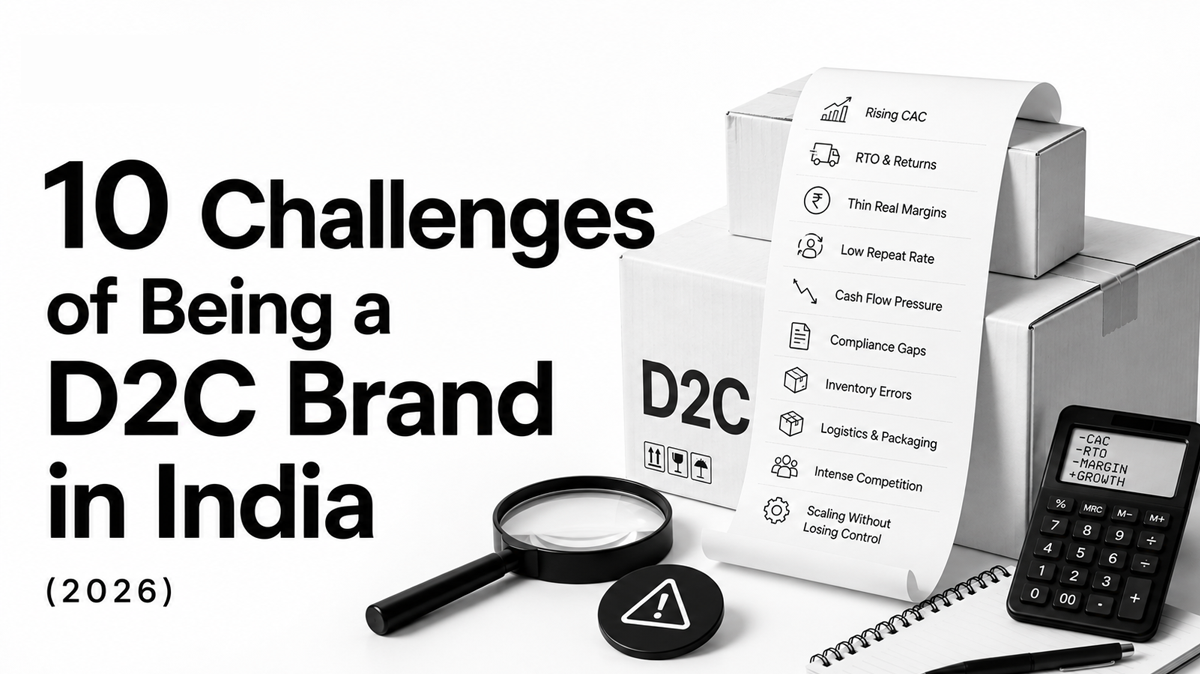
D2C in India in 2026 is a genuinely harder game than it was even two years ago. Customer acquisition costs have risen sharply, return-to-origin rates remain high despite improvement, and over 1,200 active D2C brands are now competing for the same customer attention. The brands that survive aren't the ones with the best product alone, they're the ones with the tightest operational and financial discipline.
Here are the 10 challenges that actually decide whether a D2C brand survives its first few years.
1. Rising Customer Acquisition Cost (CAC)
Digital advertising costs in India have climbed steadily, with average Meta ad CAC rising from around ₹380 in 2025 to roughly ₹502 in 2026, a jump of over 30% in a single year. In categories like beauty and personal care, CAC can run ₹800 to ₹1,200 per customer. This means a first sale is often not profitable on its own. Profitability depends entirely on what happens after that first purchase.
2. Return-to-Origin (RTO) and Failed Deliveries
RTO rates in Indian D2C have improved but remain high, dropping from around 39% to roughly 21% industry-wide through better address verification and delivery tech, though individual brands still see wide variation. Every RTO shipment costs a brand 1.5 to 2 times the original shipping fee once forward shipping, return shipping, packaging, and wasted ad spend are counted. Cash-on-delivery, which still accounts for a large share of Indian D2C orders, is a major driver of this problem.
3. Margins That Look Better on Paper Than in Practice
Gross margin numbers in D2C can be misleading. A 60% gross margin product can still lose money per order once CAC, RTO losses, payment gateway fees, packaging, and shipping are subtracted. Founders who only track gross margin, without factoring in the full cost of acquiring and fulfilling each order, often discover the real number much later than they should.
4. Low Repeat Purchase Rates
Retention is now the clearest dividing line between D2C brands that survive and ones that don't. Brands with a 25% or higher repeat purchase rate report profit margins roughly 3.4 times higher than brands with under 15% repeat rate. Acquiring a customer once is expensive. The business only becomes sustainable when that customer comes back.
5. Cash Flow Pressure From Marketing Spend
Unlike B2B, where payment terms create cash flow lag, D2C cash flow pressure usually comes from the opposite direction: spending on marketing before revenue from that spend has fully come in, especially when RTO and returns delay when cash actually settles. Founders who don't track cash flow separately from revenue can find themselves technically profitable and still short on cash.
6. Compliance and Financial Blind Spots
This challenge doesn't get discussed as often as CAC or logistics, but it quietly affects every brand: revenue can look healthy while GST filings, invoicing, and financial records stay fragmented and disorganized. We call this <u>Laabha Mayakkam</u>, the Profit Illusion, a business that's genuinely making money but can't prove it cleanly to a bank, investor, or auditor when it matters. This gap doesn't show up in daily operations. It shows up the moment someone outside the business asks to see the numbers.
7. Inventory and Demand Forecasting Errors
Overordering ties up working capital in unsold stock. Underordering means missed sales during demand spikes. Both are common in early-stage D2C, where founders don't yet have enough sales history to forecast accurately, and both directly affect cash flow and margin.
8. Packaging and Logistics Costs
Oversized or fragile packaging increases shipping costs, damages margins, and inflates return rates. Many founders design packaging around brand aesthetics first and shipping realities second, then discover the cost impact only after their first few hundred orders.
9. Intense, Growing Competition
With well over 1,200 active D2C brands now operating in India, categories that felt wide open a few years ago are increasingly crowded. Standing out increasingly requires a genuinely clear positioning, not just good products or good ads, since both are now table stakes rather than differentiators.
10. Scaling Without Losing Operational Control
Many D2C brands grow revenue faster than they grow the systems needed to support that revenue. Fulfillment, customer support, compliance, and financial tracking all need to scale alongside sales, or the brand starts breaking in ways that are expensive and slow to fix, exactly when growth should be paying off.
The Common Thread
Almost every challenge on this list comes back to the same root issue: visibility. Brands that know their real CAC, real margin, real RTO cost, and real financial position can make fast, accurate decisions. Brands operating on gut feel and scattered spreadsheets discover these problems only after they've already cost money.
Frequently Asked Questions
Why do D2C brands struggle with profitability even with good sales?
Because gross revenue and margin don't account for the full cost of acquiring and fulfilling each order, CAC, RTO, packaging, shipping, and payment fees. A brand can have strong sales and still be unprofitable per order without knowing it.
What's the biggest hidden challenge in D2C beyond marketing and logistics?
Financial and compliance visibility. Many profitable D2C brands can't produce a clean, structured financial history when a bank or investor asks for one, because records were never consistently maintained from day one.
Is D2C becoming harder to succeed in?
Yes, competition and CAC have both risen significantly in the last two years. Retention and operational discipline now matter more than raw growth, which is a shift from the earlier, discount-driven growth era.
Where TalamOne Fits
Most of the challenges on this list are hard to solve directly. But challenge #6, the compliance and financial blind spot, is solvable from day one. <u>TalamOne</u> is a structured execution layer that keeps GST-aware invoicing, compliance tracking, and financial records clean as you grow, so at least one of these ten challenges never becomes the one that catches you off guard.